Home » Venice Gondola Rides » Where Do Gondola Rides Start in Venice?
Where Do Gondola Rides Start in Venice?
Table of Contents
Gondola rides in Venice do not leave from one central terminal. They depart from official gondola stations, known locally as stazi, located throughout the historic center. Popular places to board include the San Marco waterfront, the area around Rialto Bridge, Santa Maria del Giglio, San Tomà and quieter parts of Cannaregio.
The best departure point depends on what you want to see. Choose San Marco for iconic waterfront scenery, Rialto for easy Grand Canal access, or stations farther from the busiest tourist areas if you prefer smaller canals and a quieter atmosphere.
Where are the main gondola departure points in Venice?
There are gondola stations across several parts of central Venice. You do not need to travel to Piazza San Marco to find one.
| Departure Area | Good For | Typical Experience | Crowd Level |
|---|---|---|---|
| San Marco | First-time visitors and iconic Venice views | Lagoon views, historic center and smaller canals | High |
| Rialto | Grand Canal scenery | Busy central waterway plus side canals | High |
| Santa Maria del Giglio | Central location without starting directly at Rialto | Grand Canal and inner canals | Moderate |
| San Tomà | San Polo and Frari area | Smaller canals with access toward the Grand Canal | Moderate |
| Cannaregio | Travelers looking beyond San Marco | Residential canals and northern Grand Canal | Generally lower |
If you prefer to reserve a departure time before arriving, you can view central Venice gondola departure times and availability here →
What are the official gondola stations in Venice?
The Comune di Venezia lists a number of official gondola stations, or stazi, operating around the historic center. These include:
- Danieli – close to the San Marco waterfront and Riva degli Schiavoni
- Molo – in the San Marco waterfront area
- Dogana – around Punta della Dogana at the entrance to the Grand Canal
- Trinità – in the central San Marco area
- Santa Maria del Giglio – between San Marco and the Accademia area
- San Tomà – in San Polo, convenient for the Frari area
- San Beneto – in central Venice
- Carbon – beside the Grand Canal close to Rialto Bridge
- Santa Sofia – on the Cannaregio side of the Grand Canal
- San Marcuola – farther north in Cannaregio
These are established gondola-service points rather than one single tourist terminal. That is useful because you can usually choose a departure point that fits naturally into the rest of your Venice itinerary.
Where should you start a gondola ride near St. Mark’s Square?
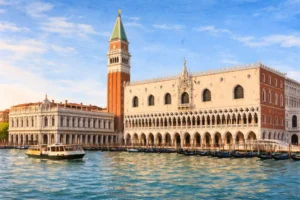
For a gondola ride close to Piazza San Marco, look toward the waterfront and the gondola stations around Molo and Danieli. This is one of the easiest areas for first-time visitors because it is close to major landmarks including St. Mark’s Basilica, the Doge’s Palace and the Bridge of Sighs.
Danieli is near Riva degli Schiavoni, only a short walk from Piazza San Marco. Rides starting in this part of Venice can begin with open views around the San Marco basin before entering narrower canals.
This part of the city delivers the visual experience many travelers imagine before arriving in Venice:
- historic palaces;
- gondolas lined along the waterfront;
- views across the lagoon;
- narrow canals behind San Marco;
- easy access from the city’s most visited landmarks.
The trade-off is popularity. The streets around San Marco and the waterways around the major gondola stations can be busy, particularly during the most popular sightseeing hours.
If your priority is the classic Venice setting rather than avoiding crowds, however, San Marco is one of the most convenient places to begin.
Where do gondola rides start near Rialto Bridge?
Rialto is another major area for gondola rides, particularly if seeing the Grand Canal from water level is important to you.
One established departure point is the Carbon gondola station near Rialto Bridge. Starting here places you directly in one of Venice’s most recognizable sections of the Grand Canal.
The experience is very different from beginning deep inside a small residential canal. The Grand Canal carries vaporetti, water taxis, delivery boats and other traffic, so there is usually more activity around you.
That is not necessarily a disadvantage. If this is your first visit, seeing the palaces lining the Grand Canal from a gondola offers a perspective that is completely different from crossing the canal on foot.
Venice and its lagoon are recognized as a UNESCO World Heritage Site, and the stretch around Rialto is one of the places where the relationship between Venice’s architecture and its waterways is particularly obvious.
Is it better to start a gondola ride at Rialto or San Marco?
Choose San Marco if landmarks and the classic Venice waterfront are your priority; choose Rialto if experiencing the Grand Canal is more important.
| San Marco | Rialto | |
|---|---|---|
| Best for | First-time visitors and famous landmarks | Grand Canal views |
| Setting | Lagoon waterfront and historic canals | Central Grand Canal |
| Boat traffic | Can be busy | Usually busy |
| Pedestrian crowds | High | High |
| Convenience | Excellent when visiting St. Mark’s attractions | Excellent when exploring Rialto |
Neither area is automatically better. The right choice depends on the kind of Venice you want to see from the water.
Where can you start a quieter gondola ride in Venice?
If you want to avoid beginning your ride in the busiest part of San Marco, consider a station farther from the major tourist concentration.
San Tomà
San Tomà is in the San Polo district, close to the Frari area. It can be particularly convenient if your itinerary already takes you through this side of central Venice.
A departure here puts you closer to a network of smaller waterways while still providing access toward the Grand Canal.
San Marcuola and Cannaregio
San Marcuola is farther north in Cannaregio. This part of Venice generally feels more residential than the immediate San Marco area and places you closer to canals that many day visitors never see.
If your goal is not simply to photograph Venice’s most famous monuments but to experience its smaller canals at water level, a departure away from San Marco can be a good choice.
Remember, however, that a quieter starting location does not guarantee that every part of your route will be empty. Canal traffic changes throughout the day.
Does the gondola departure point change the route?
Yes. The departure point is one of the biggest factors affecting what you see during a gondola ride.
A gondola beginning near Rialto cannot follow exactly the same initial route as one beginning in Cannaregio or beside the San Marco waterfront.
Depending on the departure point, a route may include:
- a section of the Grand Canal;
- small residential canals;
- historic palaces;
- small bridges and narrow waterways;
- busy central sections;
- quieter neighborhood canals.
The precise route can also be affected by water traffic, tides, operating conditions and the gondolier’s navigation decisions. If seeing a particular landmark is essential to you, check the advertised route or ask before boarding rather than assuming every gondola ride passes the same sights.
This is especially important if you specifically want to see the Bridge of Sighs or spend part of the ride on the Grand Canal.
Can you choose where your gondola ride starts?
Yes, if you are arranging the ride directly at a gondola station, you can simply go to the station in the part of Venice where you want to begin.
With an online booking, however, the departure or meeting point is normally specified by the activity operator. You should therefore check the meeting-point details before paying rather than assuming you can board at any gondola station.
This distinction matters because an online gondola ride might depart from a particular station even if another station is closer to your hotel.
If location is important, check the meeting point and available departure times before booking →
How do you recognize an official gondola station?
Official gondola stations are established boarding points for licensed gondola services. Around Venice you will commonly see gondolas moored together beside a signed boarding area.
You can find a departure point by:
- walking directly to an established gondola station;
- checking the gondola stations listed by the Comune di Venezia;
- asking your accommodation for the nearest station;
- using the meeting-point information included with an advance reservation.
Official visitor information is also available through Venezia Unica.
Do gondola prices change depending on where you start?
The official standard gondola fare does not become cheaper simply because you choose a less touristy gondola station. Standard gondola-service fares are regulated by the City of Venice.
The current official Comune di Venezia gondola tariff is:
| Service | Official Fare | Standard Duration | Maximum Passengers |
|---|---|---|---|
| Daytime | €90 per gondola | 30 minutes | 5 |
| Evening | €110 per gondola | 35 minutes | 5 |
The daytime tariff applies until 19:00; the evening tariff begins from 19:00. Longer services are priced proportionally.
These are per-gondola rates rather than per-person rates for the standard service. Online products can have different pricing structures because they may be shared rides, private reservations, guided combinations or packages with additional services.
For a more detailed explanation, see our guide to how much a gondola ride costs in Venice.
Does every gondola ride go on the Grand Canal?
No. Do not assume that every gondola ride includes the Grand Canal.
Some departure points provide easy access to it, while other routes focus more heavily on Venice’s smaller canals.
This is one of the reasons the departure point matters so much. If riding on the Grand Canal is a priority, look carefully at the route description when booking or ask the gondolier about the planned route before departure.
On the other hand, many travelers actually prefer the smaller canals. They are narrower, quieter and allow you to see details of Venice’s buildings, bridges and water entrances that are difficult to notice from the street.
What is the best departure point for a first gondola ride in Venice?
There is no single departure point that suits everyone, but the decision becomes easier if you match it to what you want from the ride.
- For iconic Venice: start around San Marco.
- For Grand Canal scenery: consider Rialto or another station with convenient Grand Canal access.
- For smaller canals: consider San Tomà or another station away from the busiest waterfront areas.
- For a more residential setting: look toward Cannaregio.
- For maximum convenience: choose the station closest to the attractions or neighborhood you are already visiting.
For many visitors, convenience is underestimated. Venice is walkable, but finding a particular meeting point through narrow streets and bridges can take longer than expected. There is little reason to cross the entire city simply because a gondola station has a famous name if another suitable departure point is close to you.
What time should you arrive at the gondola departure point?
If you are walking up to an official gondola station without a reservation, you can ask about the next available departure when you arrive.
If you have booked online, follow the meeting instructions on your booking confirmation and arrive early enough to locate the correct meeting point. Venice’s street layout can be confusing even when two places appear very close together on a map.
The time of day can also change the atmosphere considerably. Morning, afternoon, sunset and evening rides each feel different.
Read our full guide to the best time for a gondola ride in Venice before choosing your departure slot.
How long is a gondola ride from the different stations?
The standard daytime gondola service is approximately 30 minutes, while the official evening service is approximately 35 minutes. The departure station itself does not automatically give you a longer ride.
Actual duration can vary slightly because Venice is a functioning water-transport city. Canal traffic, tides and weather conditions can affect navigation.
If ride length is an important part of your decision, see our complete guide to how long gondola rides last in Venice.
What should travelers with limited mobility know about gondola departure points?
Gondola boarding is very different from boarding a large passenger boat. You generally step down from the edge of a landing point into a narrow floating boat, and the gondola moves as passengers enter.
If someone in your group has reduced mobility, difficulty with steps or balance concerns, check the boarding arrangements before booking rather than assuming every gondola station has identical access.
If gondola boarding is unsuitable, Venice can still be experienced from the water using the public transport network operated by ACTV.
Should you walk up to a gondola station or book in advance?
Both approaches work, but they solve different problems.
Walking up gives you flexibility. If you see a gondola station in an area you like, you can check availability directly.
Booking in advance is more useful when you want a specific time, know exactly where you need to meet, or do not want to spend part of your sightseeing time checking different stations.
Sunset and other popular periods can have higher demand, so travelers with a fixed schedule may prefer to reserve.
Before deciding, see our guides explaining why you may want to pre-book a gondola ride in Venice and how online gondola booking works.
Check gondola ride availability and meeting points →
Frequently asked questions about Venice gondola departure points
Is there one main gondola station in Venice?
No. Venice has multiple official gondola stations across the historic center. San Marco and Rialto are among the best-known areas, but they are not your only options.
Can I get a gondola directly from St. Mark’s Square?
There are several gondola departure points very close to Piazza San Marco, particularly around the waterfront. You do not board from the square itself.
Can I get a gondola near Rialto Bridge?
Yes. The Carbon gondola station is located close to Rialto Bridge and provides convenient access to the Grand Canal.
Do all Venice gondolas follow the same route?
No. Routes vary according to departure station, canal conditions, water traffic and the service booked.
Do all gondola rides include the Bridge of Sighs?
No. If seeing the Bridge of Sighs from the gondola is important to you, choose an appropriate San Marco-area route and verify the itinerary before booking.
Do all gondola rides include the Grand Canal?
No. Some routes include a Grand Canal section while others spend more time in smaller canals.
Can I choose my gondola station when booking online?
It depends on the activity. Online bookings normally provide a defined meeting point, so check the location before completing your reservation.
Are gondola prices cheaper in Cannaregio than in San Marco?
The city’s standard regulated gondola tariff is not based on whether you depart from San Marco, Cannaregio or another official station. Online tours and special packages can have separate pricing.
Can children take a gondola ride?
Children can travel on gondolas, but they count toward the permitted passenger capacity. Check the specific conditions of any online activity before booking.
So, where should you start your gondola ride in Venice?
For the classic first-time Venice experience, San Marco is the easiest choice. For Grand Canal views, Rialto is particularly convenient. For travelers who prefer smaller canals and less emphasis on the busiest landmarks, San Tomà or Cannaregio can be more suitable.
Most importantly, do not treat the departure point as an unimportant detail. It influences the first part of your route, the scenery around you and how much time you spend on large waterways versus narrow canals.
If you already know exactly what you want from the experience, choose the departure area first and then compare available rides from there.
For a complete overview of prices, routes, booking options and practical advice, visit our Venice Gondola Ride Hub Page.