
Home » Venice Airport Transportation » Alilaguna vs Venice Airport Bus: Which Is Better?
Alilaguna vs Venice Airport Bus: Which Is Better?
Arriving at Venice Marco Polo Airport (VCE), most travelers face the same practical question within minutes of landing: should I take the Alilaguna boat or the airport bus into Venice? Both are popular, both are legitimate, and both can work well—but they solve very different problems.
This comparison focuses on real-world trade-offs: time, effort, luggage handling, arrival points, reliability, and how each option feels after a flight. The goal is not to crown a universal winner, but to clarify which option is better for your specific situation.
Powered by GetYourGuide
The two options in one glance
| Factor | Alilaguna Boat | Airport Bus |
|---|---|---|
| Transport type | Boat (lagoon + canal stops) | Road bus |
| Main arrival points | Venice lagoon stops (Fondamente Nove, San Zaccaria, Rialto nearby) | Piazzale Roma or Mestre |
| Typical travel time | 60–75 minutes (stop dependent) | 20–30 minutes (to Piazzale Roma) |
| Luggage handling | You carry it on and off the boat | Stored below or near seat |
| Walking after arrival | Usually short (if stop is nearby) | Often longer (bridges + streets) |
| Weather exposure | Medium (open docks, lagoon) | Low |
| First impression of Venice | Strong and scenic | Neutral and functional |
Alilaguna boat: what it does well
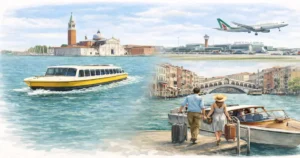
The Alilaguna is a public boat service that connects Marco Polo Airport directly to Venice by water. You leave the terminal, walk to the dock, and board a large, covered boat that follows a fixed route through the lagoon and into the city.
The biggest advantage is location. If your accommodation is near an Alilaguna stop, this option reduces the amount of walking and bridge-crossing required with luggage. For many hotels in Castello, Cannaregio, or near San Marco, the drop-off is noticeably closer than any bus-based solution.
Another advantage is continuity. You land, follow signs to boats, and stay on the same vehicle until Venice. There is no intermediate transfer from land to water, which matters more than people expect after a flight.
That said, the Alilaguna is not fast. Boats move at regulated lagoon speeds and stop multiple times. During peak hours, boarding can take longer, and in very rough weather, the ride can feel exposed, even if technically safe.
Real traveler impressions
- Anna, Germany: “Landing and immediately getting on a boat felt right for Venice. It took longer than the bus, but I walked only three minutes to my hotel.”
- James, Canada: “The scenery was great, but after a red-eye flight I underestimated how long 70 minutes feels on a boat with luggage.”
Check Alilaguna boat transfer availability
Venice airport bus: what it does well
The airport bus connects Marco Polo Airport with Piazzale Roma (the road gateway to Venice) and Mestre. Buses are frequent, clearly signed, and fast. From a purely time-based perspective, they are the most efficient public option.
For travelers staying near Piazzale Roma, Santa Croce, or on the edge of Dorsoduro, the bus can be both cheaper in effort and faster overall. Luggage storage is straightforward, seating is predictable, and weather plays almost no role.
The main drawback appears after arrival. Piazzale Roma is not Venice “proper” in the romantic sense—it is a busy transport node. From there, most people still need to walk across bridges or switch to a vaporetto with their luggage.
Real traveler impressions
- Marco, Italy: “The bus was quick and simple. The downside was dragging suitcases over two bridges after Piazzale Roma.”
- Sophie, UK: “After a long flight, I just wanted speed. The bus did exactly that.”
View Venice airport bus transfer options
Time vs effort: the real trade-off
Comparing Alilaguna and the bus purely on speed misses the point. The actual decision is about how time is distributed.
- The bus concentrates effort after arrival (walking, bridges, transfers).
- The boat distributes effort during the ride (longer travel, multiple stops).
For travelers with heavy luggage, mobility limits, children, or hotels near boat stops, reducing post-arrival effort often matters more than saving 30 minutes.
Cost considerations (realistic, not theoretical)
Ticket prices fluctuate slightly, but the gap between Alilaguna and the bus is not dramatic. What matters is whether additional tickets are required.
- Bus + vaporetto combination often costs more than expected.
- Alilaguna can eliminate the need for a second ticket on arrival.
In practice, the “cheaper” option depends on how much walking and transferring you avoid.
Weather, crowds, and flight timing
Weather affects these two options differently. Strong wind, rain, or cold make lagoon boarding less pleasant, though services still run reliably. Buses are largely immune to weather but can be crowded during peak flight waves.
Late arrivals also matter. Bus services run late, but missed connections create delays. Alilaguna boats run on fixed schedules; missing one can add significant waiting time.
Which one is better? Scenario-based verdict
Alilaguna is usually better if:
- Your hotel is near an Alilaguna stop
- You want minimal walking with luggage
- This is your first time in Venice and you want a calm arrival
The bus is usually better if:
- You value speed above comfort
- You are staying near Piazzale Roma
- You are familiar with Venice logistics
Useful planning context
Airport operations, schedules, and seasonal changes are managed by the official operator of Venice Marco Polo Airport, while alternative routes via Treviso are covered by Treviso Airport.
Related internal guides
For deeper planning, these guides provide more targeted breakdowns:
FAQs
- Does Alilaguna go directly to hotels?No. It stops at fixed docks. Some hotels are very close; others require short walks.
- Is the airport bus always faster?Yes in driving time, but total journey time can increase due to walking and transfers.
- Which option handles large suitcases better?The bus is easier during the ride; the boat is easier after arrival.
- Are Alilaguna boats enclosed?They are covered, but boarding areas are exposed.
- Can I buy tickets on arrival?Yes for both, but advance booking reduces uncertainty.
- Is one option safer at night?Both are safe; buses feel more controlled late at night.
- What if my flight is delayed?Bus frequency offers more flexibility; boats require schedule awareness.
- Which is better for families?Families often prefer Alilaguna to avoid post-arrival walking.
- Does Alilaguna run year-round?Yes, with seasonal timetable adjustments.
- Is Mestre a good drop-off?Only if your accommodation is there; otherwise it adds a transfer.
- Are buses crowded?They can be during peak flight hours.
- Can I combine options?Yes, but this often negates cost and comfort benefits.
See airport transfer options based on hotel location
Compare All Airport Transfer Methods
Still deciding? Our complete
Venice Airport Transportation guide
compares pricing, travel time, and convenience across all available routes.