
Home » Venice Airport Transportation » Airport Bus vs Taxi from Marco Polo Airport
Airport Bus vs Taxi from Marco Polo Airport
Landing at Venice Marco Polo Airport is usually smooth. The real decision comes right after baggage claim: airport bus or taxi? This is not a theoretical choice. It affects cost, comfort, time, luggage handling, and your first physical interaction with Venice’s geography.
This guide compares airport bus and taxi from Marco Polo Airport using real traveler behavior, observed bottlenecks, and practical trade-offs. It focuses on what actually changes your arrival experience, not generic transport theory.
Powered by GetYourGuide
What “bus vs taxi” really means at Marco Polo Airport
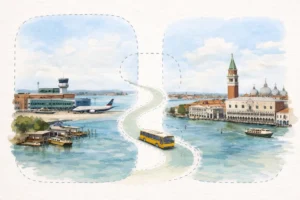
At Venice Marco Polo Airport, a “bus” means a scheduled airport coach running on fixed routes toward Mestre or Piazzale Roma. A “taxi” usually means a licensed water taxi that leaves directly from the airport dock and brings you close to your hotel.
The choice is not only about price. It is about how many steps your arrival has, how predictable the transfer is, and how well it fits your accommodation location.
Cost comparison: fixed price vs variable convenience
The airport bus is the lowest-cost option. It offers predictable pricing that does not change with traffic, luggage size, or time of day. The trade-off is that you are paying with time and physical effort.
Taxi transfers are significantly more expensive. The price reflects private space, fewer steps, and proximity to your destination. Cost increases with distance, shared usage, and late-night schedules.
In practice, travelers underestimate how many “hidden” costs appear after choosing the cheapest option: additional vaporetto tickets, bridge crossings with luggage, and time lost orienting.
Observed traveler pattern
- Solo travelers with backpacks usually tolerate the bus well.
- Couples with rolling suitcases often regret the bus once inside Venice.
- Families or groups with children rarely feel the bus savings were worth it.
View current Marco Polo Airport bus ticket options
Travel time: clock time vs real arrival time
On paper, airport buses reach Venice in 20–30 minutes. Taxis vary widely, often between 30–50 minutes. On a stopwatch, buses look faster.
In reality, arrival time is not when the vehicle stops. It is when you reach your accommodation entrance.
Bus arrival often triggers:
- A walk from Piazzale Roma
- A vaporetto transfer
- Bridge crossings with luggage
- Queueing for tickets if not pre-booked
Taxi arrival usually ends close to the hotel door if a water-accessible dock exists. Even when walking remains, distances are short and predictable.
Luggage handling: where the comparison becomes physical
Luggage is the single most underestimated factor in this decision.
Airport buses are luggage-friendly up to the drop-off point. After that, Venice becomes a pedestrian city with bridges and narrow walkways. Large suitcases turn minor distances into slow obstacles.
Taxis eliminate most lifting, dragging, and re-routing. You step on, sit, and step off near your destination.
Weather and timing sensitivity
Bus transfers perform best in stable weather and daylight hours. Rain, high water, or late-night arrivals reduce their practicality.
Taxis remain usable in poor weather and at night. This reliability is why locals recommend them for winter arrivals or flights landing after 20:00.
Stress level and decision fatigue
After a flight, travelers have limited cognitive energy. The bus requires:
- Correct line selection
- Correct stop recognition
- Secondary transport decisions
Taxis require a single decision and minimal orientation. This matters more than most guides admit.
Check water taxi transfers from Marco Polo Airport to Venice hotels
Accommodation location: the deciding variable
Your hotel location should override generic advice.
Bus is usually acceptable if:
- You stay in Mestre
- You stay near Piazzale Roma
- You travel light
Taxi is usually better if:
- Your hotel is deep inside Venice
- You arrive late or early
- You carry multiple suitcases
Official infrastructure realities
Marco Polo Airport is designed for multimodal transfers, but Venice itself is not. Airport planning does not remove historic constraints inside the city.
According to official information from Venezia Airport, ground transportation ends at Piazzale Roma for wheeled vehicles. Beyond that point, water and walking dominate.
This structural fact explains why taxis feel disproportionately valuable compared to their cost.
Experienced traveler reviews
“We saved money with the bus but spent it all in energy. After two bridges with luggage, the savings didn’t feel real.” — Anna, Germany
“Water taxi cost more, but it dropped us 30 meters from our hotel. After a late flight, that mattered.” — Marco, Italy
“Bus worked fine for us, but only because we stayed in Mestre and arrived in the afternoon.” — Claire, France
Secondary transport overlaps
Bus arrivals often connect with vaporetto lines. Understanding the local network helps avoid confusion. Resources such as AskVenice Tourism Info clarify stop layouts and walking distances.
Summary comparison table
| Factor | Airport Bus | Taxi |
|---|---|---|
| Cost | Low | High |
| Steps involved | Multiple | Minimal |
| Luggage effort | High after drop-off | Low |
| Late-night reliability | Moderate | High |
| Hotel proximity | Indirect | Often direct |
Frequently Asked Questions
1. Does the airport bus run during early morning flights?
Yes, but frequency is reduced before 6:00. Waiting time can exceed expectations.
2. Are airport buses crowded during peak season?
Yes. Summer afternoons and holidays often result in standing passengers.
3. Can taxis reach all Venice hotels?
No. Some hotels lack private docks, requiring a short walk after disembarkation.
4. Is luggage size restricted on buses?
Officially no, but practical space is limited during busy periods.
5. Are taxis affected by acqua alta?
Yes, but they adapt better than land-based transport during high water.
6. Is tipping expected for taxi drivers?
Tipping is not mandatory, but rounding up is appreciated.
7. Can buses be delayed by traffic?
Yes, especially during weekday rush hours near Mestre.
8. Are children charged full price on buses?
Policies vary by operator; age thresholds apply.
9. Is advance booking required for taxis?
Not required, but advance booking reduces waiting time.
10. Do taxis operate year-round?
Yes, though availability drops slightly during off-season nights.
11. Is the bus suitable after a long-haul flight?
Physically yes, mentally often less so due to added steps.
12. Does travel insurance cover taxi transfers?
Only if explicitly included; standard policies usually do not.
See shared water taxi transfers from Marco Polo Airport to Venice hotels